Spiritual Care
within Palliative Care
Spiritual care is neither a single intervention nor an
independent discipline within palliative care, but must be seen as an integrated
and indispensable part of a proper palliative care system.
We humans experience life as a three-dimensional reality:
We perceive ourselves as individuals
-
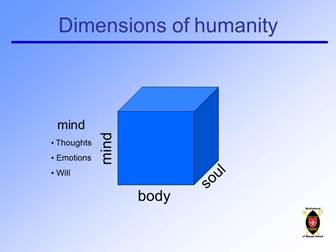 in
the physical dimension of our body
-
equipped with the cognitive and psychological
dimension of our mind that enables
us
-
to think,
-
to feel, harbour and express emotions and
-
to control our thoughts and actions by its
willpower/volition
-
and in the spiritual dimension of our
soul.
Each individual lives in the social context of
relationships to other individuals and groups.
Health may therefore be defined as physical, psychological,
social and spiritual wellbeing, meaning to be in well-balanced eutonic state of
feeling and being well in body, mind and soul and in one's social relations.
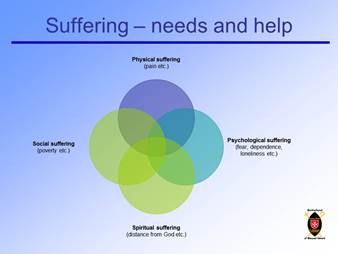 Where
one or more of these constituents of health are compromised, we suffer
individually and in our social context. Our human dimensions are
inter-dependant, i.e. they will be mutually affected by an imbalance: There are
psycho-somatic disorders caused by psychological distress (like fear) and
vice-versa bodily symptoms (like pain) will cause psychological discomfort.
Social problems (like poverty or interpersonal frictions) will not only cause
psychological suffering, but may negatively influence our state of physical
health as well. A patient often suffers
spiritually as a consequence of the lack of physical, psychological and social
well-being. S/he may feel abandoned or even punished by whatever higher being
(godhead) or transcendent powers s/he believes in.
Different definitions of "Psyche" have led to quite some
confusion. Many pastoral workers, e.g. ministers of religion, therefore consider
it their (primary or only) task and role to render psychological or
psycho-social assistance to their flock trying to alleviate their fears or to
restore their interpersonal relationships. Although a pastoral worker / minister
of religion must not neglect these dimensions at all, her/his primary task (and
speciality) is to attend to a suffering person's soul. I would like to define
"soul" as the ability, place and power of each individual to get into contact,
establish and maintain a relationship and harmony with whatever transcendent
powers or higher being s/he believes in. Different faith-systems of course have
different views of transcendence and it would go too far for this paper to
reflect on these. Some religions believe in one or several godhead/s, some
faith-groups believe in good and/or evil spirits, some in a philosophical system
of atheistic goodness and righteousness etc.
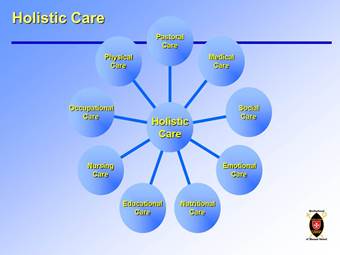 If
we want to render a truly holistic palliative care we must not just administer
physical care (attending to the medical, nursing and nutritional needs),
psychological care (attending to the emotional, occupational and educational
needs), social care (attending to the patient's interpersonal and economical
needs), but also spiritual care (attending to the needs of her/his soul).
Rendering spiritual care it is absolutely essential and
indispensable
-
to come to know and tolerate if not respect and
value each individual's philosophy of life, world view and religious views and
-
to refrain from judging, from trying to correct
such views, philosophies or ideologies, or even from trying to proselytise.
The aim of spiritual care is to create an atmosphere, time
opportunity and personal freedom for the patient to enable her/him to practice
her/his religion and - if necessary - to restore her/his harmony with her/his
religious aims and ideals or godhead. The patient may request the assistance of
a minister of religion of her/his faith, may desire to perform acts of divine
worship, s/he may want to participate in religious services, prayers,
meditation, offerings, chanting or whatever spiritual exercises or practices
her/his religion entails. It must take high priority for us to enable and
facilitate these as far as reasonably possible.
Good spiritual care may be the crown and completion of our
palliative care, more so because it is preparing the individual for the
eschatological event of his passing into - what most religions believe in - life
after death and palliative care is all about enabling the patient to live
her/his life in dignity and comfort - not just until "the end" - but forever.
Father Gérard T. Lagleder O.S.B.
father@bbg.org.za