
Qalile Uhlelo* a 39 year old lady walked into Blessed Gérard’s Hospice in August 2004 looking for help. She was very ill with all sorts of opportunistic infections. She openly admitted that she was HIV positive and had heard that Blessed Gérard’s Care Centre had started an antiretroviral therapy programme.
Qalile was interviewed. She answered all the questions openly and without reservation. She lives within the municipal area of Mandeni and was committed to staying alive. Her employer was fully supportive of her and encouraged her to go ahead with the treatment.
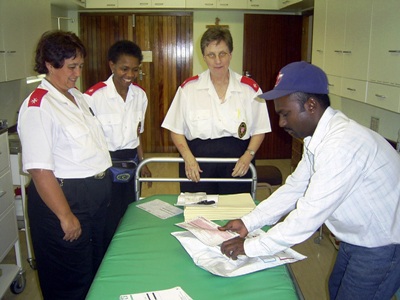 The first batch of blood samples being collected by the courier service to be transported to the laboratory. |
At the beginning of September we drew her blood for a baseline reference test. The shock came when her results were received. With a CD4 count of 1 cell per mm³ and an extremely high viral load of 90536 copies/ml, it was incredible that she was still able to walk. A person who is HIV-negative would have a CD4 count of between 800 and 1300 cells per mm³.
We offered Qalile to be admitted into Blessed Gérard’s Hospice as an inpatient, because of her bad state of health, which she accepted. Qalile was a model patient and complied with all that was asked of her. Antiretroviral therapy is not as simple as taking painkillers and requires thorough education and commitment on the part of the patient. Therefore it is a condition that all candidates for the HAART programme must undergo four weeks of ARV treatment literacy training to learn, understand, accept and follow all the aspects of the treatment from disclosure to adherence.
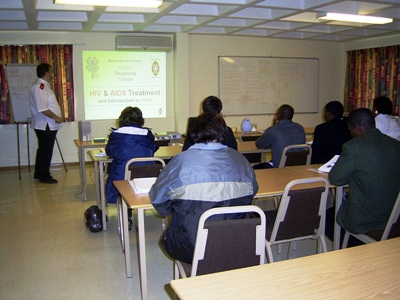 The first HAART readiness course |
The first week of the drug readiness course arrived. It was Tuesday morning and all was prepared. Unfortunately Qalile had developed severe diarrhoea and vomiting. Our medical doctor prescribed the necessary medication to control this, but it continued unabated. Qalile became weaker and we were worried that her life was seriously in danger. Slowly, one day at a time, she responded to the treatment. The diarrhoea and vomiting subsided but she had since developed peripheral neuritis and therefore could not walk any more, it was too painful for her to put her feet on the floor.
Qalile fought back. She overcame her opportunistic infections to the extent that our doctor decided to give her individual tuition for module one of the drug readiness course. She showed great enthusiasm, which even inspired other patients, the doctor, the nurses and caregivers and they continued to encourage her. The second week of the drug readiness course came and went without any further problems, as happened with the third and the fourth modules. At this time she sat with our doctor and planned her treatment – what time will she be able to take her drugs every day, where will she keep them, what will she keep them in? Qalile answered all these questions with the guidance of the doctor.
Having completed this process, it was time to read and understand the
treatment contract. This was explained to her in length. Qalile listened
attentively as she was asked to commit herself to living a positive, healthy
life and to abide by the rules of the HAART Programme. Qalile excitedly signed
the contract. The director of Blessed Gérard’s Care Centre also signed the
contract, promising to give her the drugs and to support her physically,
psychologically and spiritually.
The time had come! Qalile’s life-prolonging drugs arrived.
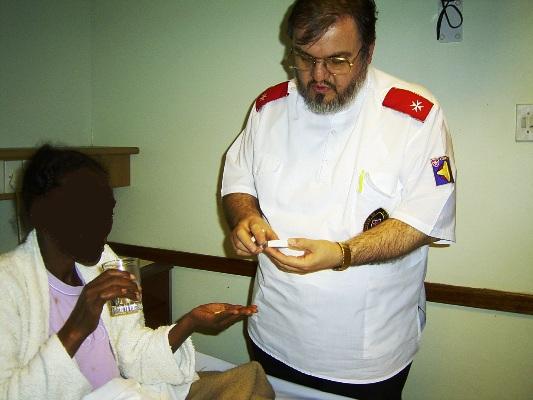 The very first time we administered HAART medication |
Day 1 – Qalile was fine;
Day 2 – Qalile felt a little nauseous;
Day 3 – Qalile started vomiting;
Day 4 – Qalile felt good;
Day 5 – Qalile felt a little stronger;
Day 6 – Qalile was discharged and went home;
Day 10 – Qalile came back to Blessed Gérard’s Hospice for a checkup. She was not
feeling too well, so it was decided to readmit her. Qalile’s Immune system was
reconstituting itself and was fighting back.
Day 17 – We decided to do some more blood tests to see how Qalile was really
improving. Her CD4 count was up to 8 cells per mm³. She was on the road to
better health. We nursed her through this period of reconstitution and when she
emerged on the other side, we discharged her home again. Qalile returned to
Blessed Gérard’s Hospice weekly for her routine visit to the doctor. On 3
November we carried out another blood test. This time her CD4 count was up to 18
cells per mm³ – which is still considered extremely low, but it does show an
improvement. The interesting figure was the viral load result, which had
decreased to 74 copies/ml. This was good news indeed.
Qalile continues to improve daily. Her CD4 count on 6 December 2004 was 39 cells
per mm³. She is still a model patient and does all that she is asked. Thank you
Qalile, for being our first HAART patient and for teaching us so much –
patience, strength of character, will power and perseverance! Thank you Qalile
for your encouragement and for showing us how well our HAART Programme can work
to greatly improve the quality of life of people living with HIV / AIDS!
* The story is true, but the name is fictitious to protect her identity.
This page is part of the Newsletter No. 24 of the Brotherhood of Blessed Gérard


Back to the homepage of the Brotherhood of Blessed
Gérard

This page was last updated on Tuesday, 15 January 2013 12:49:53